
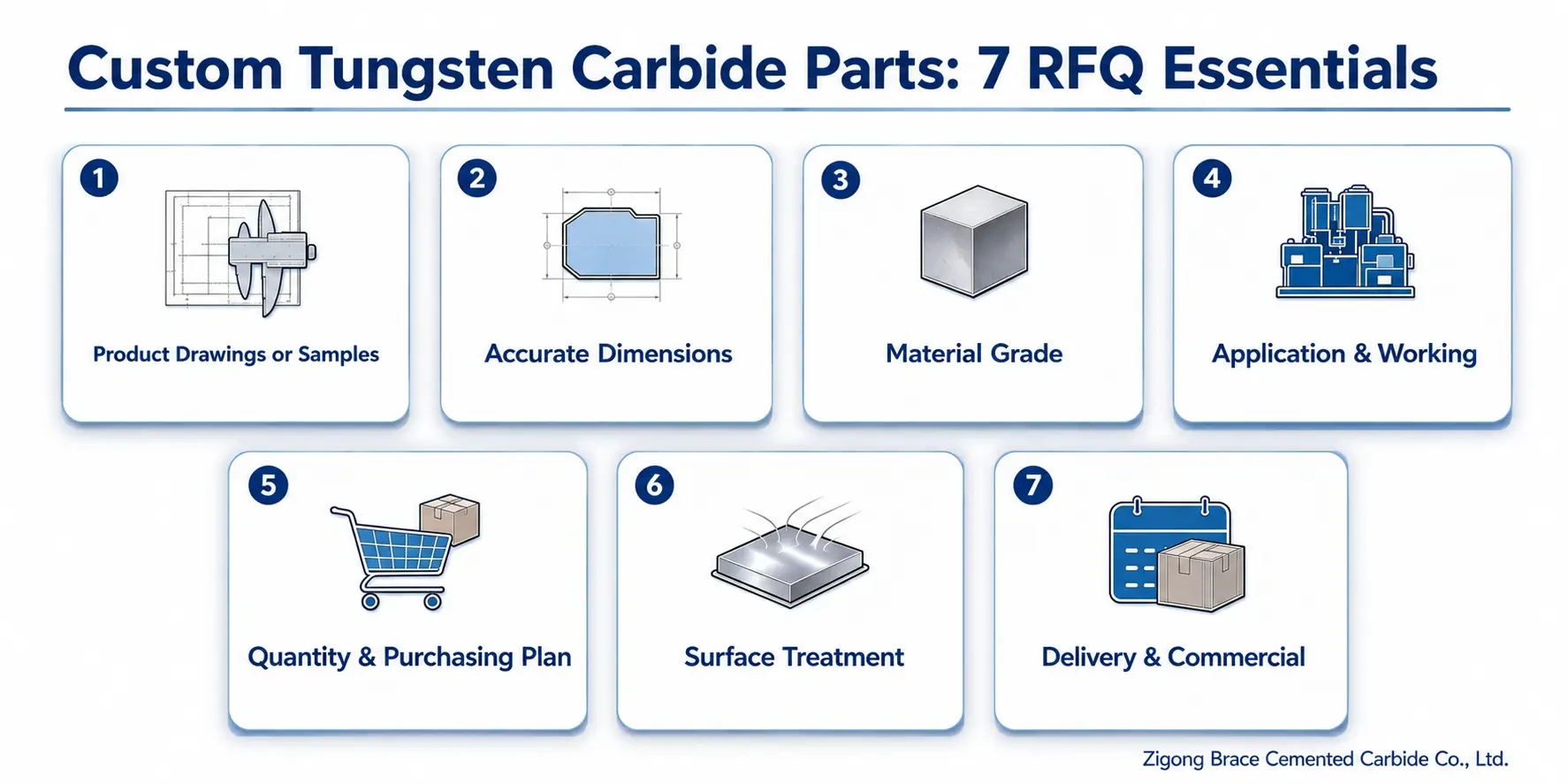
When purchasing custom tungsten carbide components, an accurate quotation starts with a clear understanding of the product requirements.
Unlike standard industrial products, many cemented carbide components are manufactured according to specific drawings, samples, dimensions, or equipment requirements.
A small difference in product geometry, material grade, or installation structure may affect the final manufacturing process and product performance.
For industrial buyers, equipment manufacturers, and OEM suppliers, preparing the right information before requesting a quotation can make communication more efficient and help reduce misunderstandings during product development.
So, what information should you provide when sourcing custom tungsten carbide parts?
Here are seven important details to consider.
1. Product Drawings or Reference Samples
An engineering drawing is one of the most useful references when requesting custom carbide components.
It helps manufacturers understand the product structure, dimensions, tolerances, mounting positions, and other important technical requirements.
If a complete drawing is not available, you can also provide:
A physical product sample
A dimensioned sketch
Clear photographs from different angles
Reference drawings of similar components
For replacement parts, an existing component can also help communicate the required shape and installation structure.
At Brace Carbide, we support custom manufacturing based on customer drawings, samples, and specifications.
2. Accurate Product Dimensions
Dimensions are essential for evaluating manufacturing feasibility and machining requirements.
Depending on the product, the information may include:
Length, width, and height
Thickness and diameter
Hole positions and hole diameters
Angles and special geometries
Required dimensional tolerances
For components that need to fit existing equipment, mounting dimensions and interface details are particularly important.
If certain dimensions are critical for installation or operation, make sure they are clearly identified in the drawing.
3. Material and Carbide Grade Requirements
Different industrial applications require different material properties.
For tungsten carbide components, important material considerations include carbide grade, cobalt content, grain structure, hardness, and toughness.
For example, components exposed to continuous abrasion may require a different material balance from those operating under heavy impact or vibration.
If you already have a specified carbide grade, include it in your inquiry.
If the grade has not been determined, provide information about the working environment so that the material requirements can be evaluated more appropriately.
Depending on the application, customers may also request other material solutions, including cermet.
4. Actual Application and Working Conditions
Knowing where and how a component will be used is just as important as knowing its dimensions.
Useful application information includes:
Equipment type and model
Materials being processed
Operating temperature
Abrasion and impact conditions
Operating speed and working frequency
Installation and contact conditions
For example, a carbide component used in plastic recycling may face different wear conditions from one used in tire recycling or mining equipment.
Understanding the actual application helps manufacturers evaluate product structure and material requirements instead of relying only on general specifications.
5. Required Quantity and Purchasing Plan
Order quantity is another important part of an RFQ.
Please indicate whether your requirement is for:
Initial samples
Small-batch production
Regular replacement orders
Long-term OEM supply
The expected purchasing quantity can influence production planning, machining arrangements, packaging, and quotation evaluation.
If you anticipate recurring orders, sharing your estimated purchasing schedule can also help suppliers better understand your project requirements.
6. Surface Treatment and Additional Requirements
Some customized carbide products involve additional manufacturing or finishing requirements.
Depending on the component, these may include:
Precision CNC machining
Grinding and polishing
Surface coating
Brazing or welding
Assembly with steel components
Special dimensional tolerances
Not every requirement applies to every product.
It is therefore helpful to specify which processes or finishing details are necessary for your application.
For carbide-tipped components, for example, the steel body, carbide cutting elements, and joining structure may all need to be considered together.
7. Target Delivery Time and Commercial Requirements
Finally, provide your expected delivery schedule and purchasing requirements.
These details may include:
Required delivery date
Destination country
Preferred packaging
Payment terms
Shipping requirements
Clear expectations at the beginning can help both parties evaluate whether the proposed production and delivery arrangements are suitable.
What If You Do Not Have a Complete Technical Drawing?
Not every purchasing project starts with a finished engineering drawing.
Some buyers are developing new equipment, replacing discontinued components, or looking for alternatives to existing products.
In these situations, a physical sample, reference photograph, basic dimensions, and application description can provide a useful starting point.
Technical details can then be discussed and confirmed during the product evaluation process.
The important thing is to communicate the actual requirements as clearly as possible.
Custom Tungsten Carbide Manufacturing by Zigong Brace
At Zigong Brace Cemented Carbide Co., Ltd., we focus on customized tungsten carbide solutions for industrial applications.
Our product range includes:
Tungsten Carbide Shredder Blades
Cermet Shredder Blades
Snowmobile Carbide Wear Bars
Custom Tungsten Carbide Wear Parts
Precision Tungsten Carbide Components
We support OEM and ODM requirements based on customer drawings, samples, and technical specifications.
Whether you are sourcing replacement wear parts, developing a new component, or looking for a customized solution for industrial equipment, our team can work with your requirements to evaluate a suitable manufacturing approach.
Have a drawing, sample, or product requirement?
Contact Zigong Brace to discuss your custom tungsten carbide project.
Website: https://bracecarbide.com/
Frequently Asked Questions
1. Can you manufacture tungsten carbide parts according to customer drawings?
Yes. We support customized manufacturing according to customer drawings, samples, and technical specifications.
2. Can I request a quotation without an engineering drawing?
Yes. You can initially provide product photographs, available dimensions, a physical sample, and application information for technical evaluation.
3. How do I select the right tungsten carbide grade?
Carbide grade selection depends on the working environment, including abrasion, impact, operating conditions, and required performance. Providing application details helps evaluate suitable material options.
4. Do you manufacture both tungsten carbide and cermet products?
Yes. We offer tungsten carbide and cermet product solutions according to specific product requirements and applications.
5. What information should I include when requesting a quotation?
Ideally, provide a drawing or sample, dimensions, material requirements, application details, estimated quantity, and delivery expectations.