
Global Tungsten Supply Chains Are Shifting Toward Long-Term Security
What Carbide Buyers Should Know
The global tungsten market is entering a new stage in 2026. Rather than watching only short-term price movements, producers and industrial buyers are starting to pay closer attention to long-term supply security, regional diversification, and reliable access to tungsten raw materials.
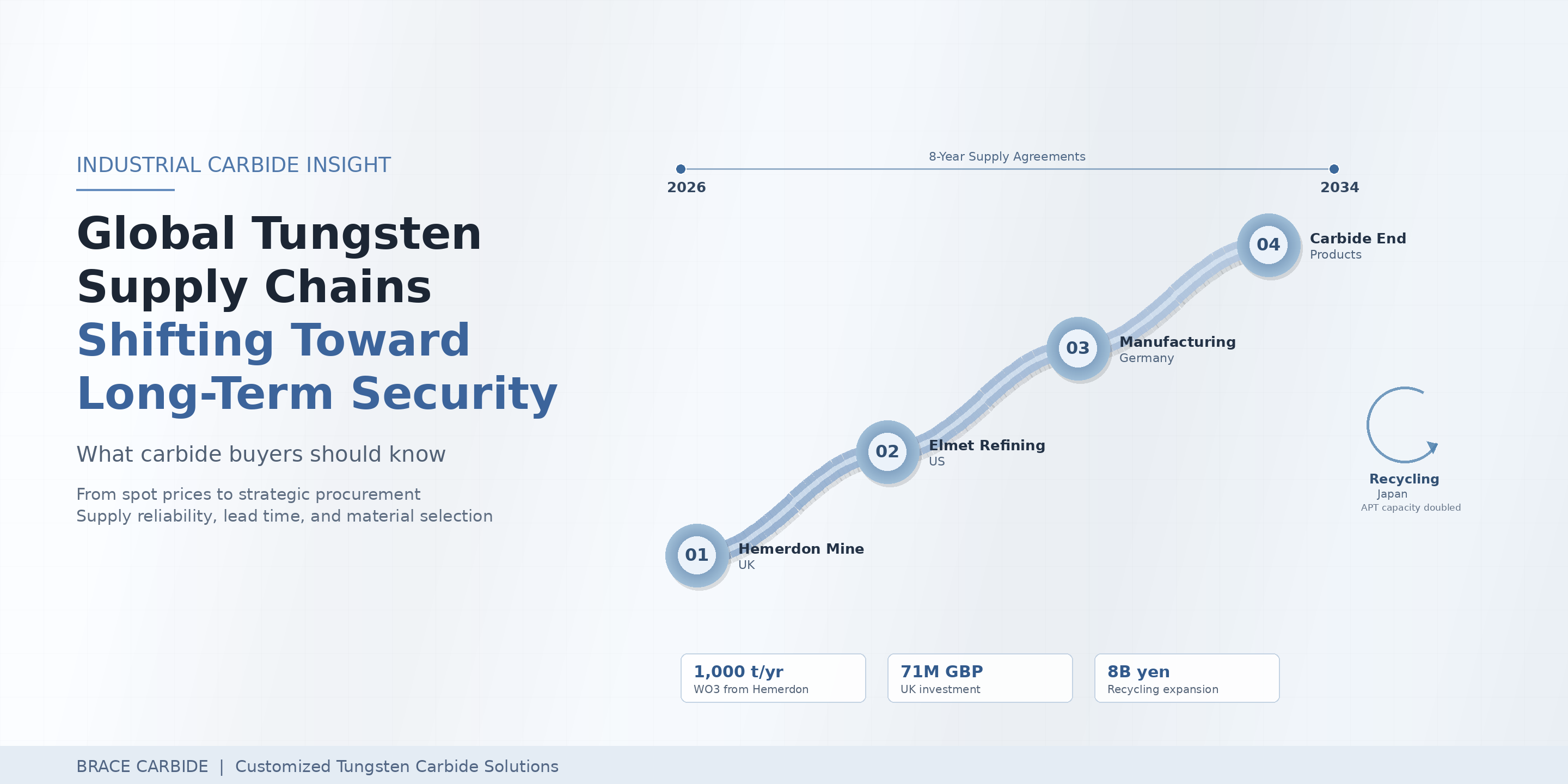
A recent development in the UK offers a clear illustration. On September 23, 2026, Tungsten West announced an eight-year supply and offtake agreement with U.S.-based Elmet Group for tungsten production from the Hemerdon mine in Devon, UK. The agreement covers approximately 1,000 tonnes per year of contained tungsten trioxide, written as WO3.
This deal reflects a wider industry shift. Tungsten supply is increasingly treated as a strategic procurement issue rather than a straightforward commodity purchase. For tungsten carbide manufacturers and industrial buyers, that shift carries real implications.
1. Why Supply Security Matters More Now
Tungsten is a critical raw material for cemented carbide, cutting tools, wear-resistant components, and a long list of other industrial uses. At the same time, tungsten supply chains remain geographically concentrated. Export controls, trade policy changes, limited mining capacity, and regional gaps in processing can all affect whether tungsten-related materials are available and what they cost.
As a result, buyers are having to ask a different question. Instead of only asking "what is today's tungsten price," they also need to ask "can I secure the material I need consistently over the next several months." That question matters most for manufacturers with long production cycles or customers who depend on stable delivery schedules.
2. The UK to US Tungsten Supply Agreement
The Tungsten West and Elmet agreement shows how companies are responding to supply chain concerns in practice. Under the eight-year arrangement, Tungsten West will supply Elmet with approximately 1,000 tonnes per year of contained WO3 from Hemerdon. Elmet said the material is expected to enter its allied refining network before being supplied to its manufacturing operations in the United States and Germany. The company described the agreement as a way to strengthen tungsten supply chains across the U.S., UK, and allied markets.
This kind of long-term arrangement works differently from short-term spot market buying. It gives downstream manufacturers better visibility into future raw material supply, while giving the upstream producer a stable customer relationship over a multi-year horizon.
3. Hemerdon Sits Inside a Wider Supply Strategy
Hemerdon is also getting backing from the UK government. In August 2026, the UK's National Wealth Fund announced an investment of up to 71 million GBP in Tungsten West to support the restart of the Hemerdon tungsten and tin mine. The package includes 36 million GBP in equity and up to 35 million GBP in lending. It also gives the UK government an exclusive negotiation period concerning the potential procurement of up to 50 percent of the mine's annual tungsten production.
Taken together, these moves show that governments and industrial companies are increasingly viewing tungsten through the lens of critical mineral supply security.
4. What This Means for Carbide Buyers
These developments do not automatically mean every carbide product will become more expensive. The more important point is that raw material supply conditions are starting to shape procurement decisions in a more direct way. Four factors deserve attention.
First, supply reliability. For regular production, consistent availability can matter as much as the initial material price. A supplier that can maintain production and communicate realistic lead times may offer better procurement visibility than one that only quotes a low short-term price.
Second, lead time. When raw material availability shifts, production schedules shift with it. Buyers with recurring requirements should factor lead time into how they evaluate suppliers.
Third, material selection. Not every application needs the same carbide grade. Choosing the right balance of hardness and toughness helps ensure the product matches the actual working conditions, especially for tungsten carbide wear parts and other components exposed to abrasion or impact.
Fourth, customized product design. Material efficiency matters too. For custom carbide components, dimensions, geometry, tolerances, and carbide grade can be evaluated together according to the application, which often works better than defaulting to a generic standard part.
5. Supply Security Is Not About Single Sourcing
Global tungsten supply diversification does not mean simply replacing one supplier or one region with another. For industrial buyers, a more practical approach may include evaluating multiple qualified suppliers, understanding where raw materials come from, maintaining realistic lead times, planning recurring orders in advance, reviewing alternative product specifications where appropriate, and building longer-term supplier relationships.
For manufacturers that use tungsten carbide components on a regular basis, these steps can reduce the impact of unexpected supply disruptions.
6. Why This Reaches Beyond Cutting Tools
The effect of tungsten supply conditions extends well beyond cutting tools. Tungsten carbide is also used in many industrial wear parts where service life and wear resistance are the priority. Typical applications include recycling equipment, industrial shredders, wear-resistant components, cutting components, material-processing equipment, and customized carbide parts.
For these applications, procurement decisions should look at the complete product rather than the raw material alone. The carbide grade, steel substrate where applicable, product dimensions, geometry, and working conditions all shape the final solution. Industrial shredder blades, for example, may need a different material combination and design depending on what is being processed and how the machine runs.
7. Custom Carbide Solutions Gain Weight
When raw material costs and supply conditions change, product design becomes a bigger part of procurement. A customized carbide component can be designed around required dimensions, carbide grade, wear conditions, impact conditions, mounting requirements, product geometry, and expected service life.
This does not mean customization automatically lowers costs. What it does is allow the product to be evaluated against the actual application instead of relying only on a standard specification. For buyers with special drawings, samples, or technical requirements, that can mean more flexibility when sourcing carbide components.
8. What Carbide Buyers Should Watch Next
As the tungsten market keeps evolving, industrial buyers may want to monitor several areas.
Raw material availability. Changes in concentrate, APT, tungsten powder, and carbide powder availability can influence downstream manufacturing.
Regional price differences. Domestic and international tungsten markets do not always move in lockstep.
New mining projects. Projects in regions outside traditional supply centers could gradually add to supply diversification.
Recycling. Tungsten recycling is becoming a more important part of supply chain strategy. In September 2026, for example, Mitsubishi Materials announced plans to invest about 8 billion yen to expand tungsten recycling capacity at its Akita operation in Japan. Annual APT capacity is expected to double to 2,400 tonnes in tungsten trioxide equivalent.
Long-term supply agreements. More multi-year agreements between mines, refiners, and downstream manufacturers may become a regular feature of the tungsten market.
9. What This Means for Industrial Procurement
For carbide buyers, the main takeaway is that procurement should not rest on a single number. Instead, buyers may want to evaluate price, material, quality, lead time, supply stability, and application performance together.
This is especially relevant for customers purchasing customized carbide components on a recurring basis. A reliable supplier should be able to understand the application, confirm specifications, provide realistic lead times, and maintain consistent product quality.
How Brace Carbide Supports Industrial Carbide Buyers
At Brace Carbide, we focus on customized tungsten carbide and cemented carbide solutions for industrial applications. Our product range includes tungsten carbide wear parts, industrial shredder blades, snowmobile carbide wear bars, and other customized carbide components.
We work with customer drawings, dimensions, samples, and application requirements to develop products around specific project needs. For industrial buyers, our focus is not simply on supplying a carbide component. It is on understanding the required material, dimensions, application, and performance requirements before production begins.
If you are sourcing customized carbide components or looking for a long-term supplier, you can contact Brace Carbide with your drawing, sample, or specification.
Conclusion
Recent developments in the tungsten industry show that supply security is becoming a more important part of the global tungsten market. The eight-year Tungsten West and Elmet agreement, along with continued investment in tungsten supply projects, show how companies and governments are working to build longer-term access to this critical material.
For tungsten carbide buyers, this means procurement decisions may increasingly need to look beyond short-term price. Supply reliability, material selection, lead time, product design, and supplier capability all influence the long-term value of a carbide component.
FAQ
Why is tungsten supply security becoming more important?
Tungsten is an important industrial raw material, while global supply and processing capacity remain concentrated in certain regions. Trade policies and supply chain changes can therefore affect availability and procurement planning.
What is the recent Tungsten West and Elmet agreement?
Tungsten West announced an eight-year supply and offtake agreement with Elmet covering approximately 1,000 tonnes per year of contained WO3 from the Hemerdon mine.
Does tungsten supply affect carbide prices?
Raw material availability and costs can influence downstream carbide manufacturing costs, although the final price of a carbide product also depends on grade, dimensions, processing, quantity, and other factors.
Can customized carbide products help with procurement?
Customized products allow buyers to specify dimensions, carbide grades, geometries, and other requirements according to the actual application. This can be useful when standard products do not match the equipment or working conditions.
What should I provide when requesting a carbide quotation?
A drawing, sample, dimensions, application information, required quantity, and working conditions can help a supplier evaluate the appropriate carbide solution.