
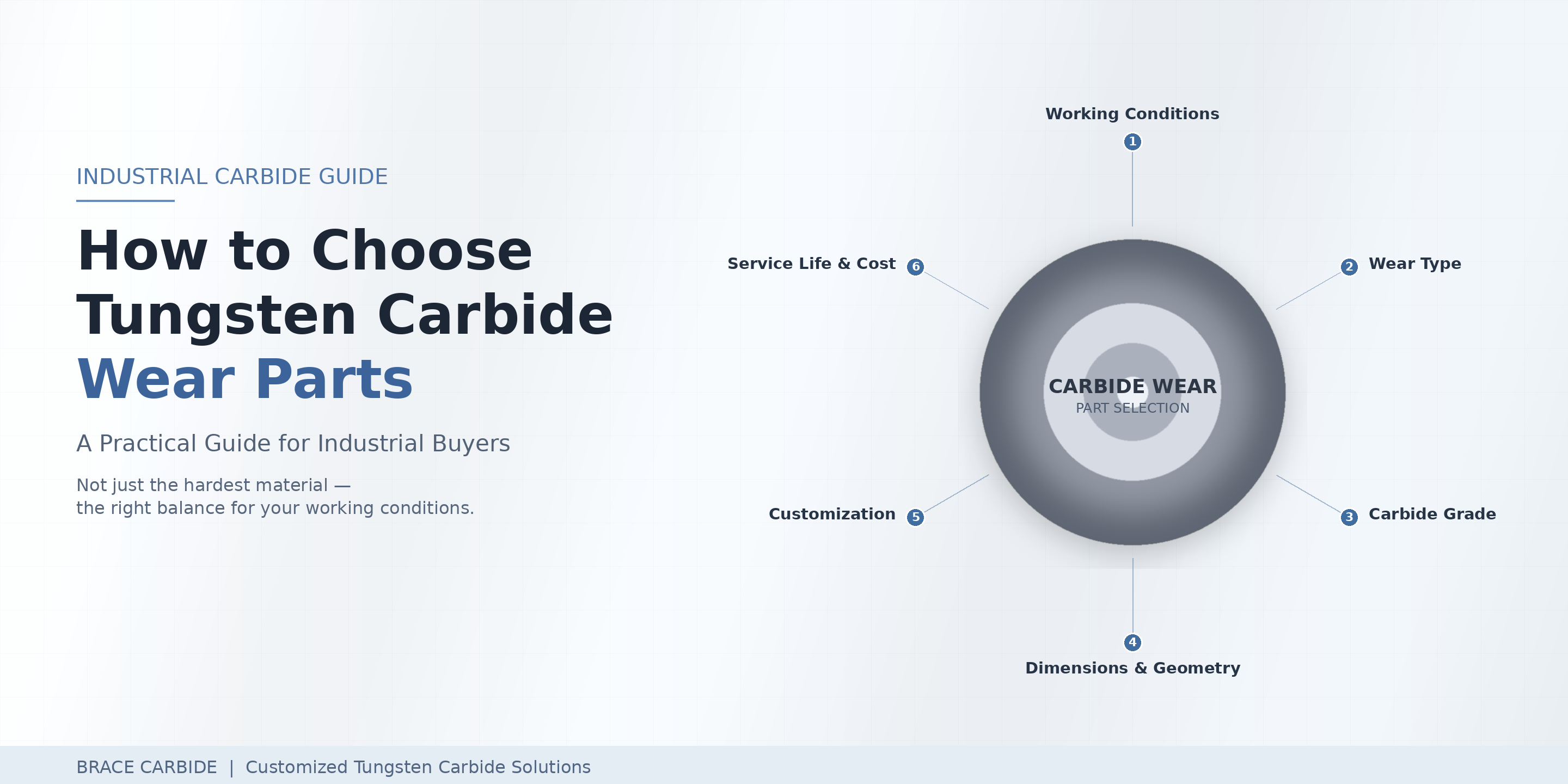
Choosing Tungsten Carbide Wear Parts
A Practical Guide for Industrial Buyers
Tungsten carbide wear parts show up across nearly every industry where machinery takes a beating. Abrasion, impact, friction, and repeated loading cycles all take their toll over time. But here is the part that gets overlooked: selecting the right wear part is rarely about picking the hardest grade on the spec sheet.
Every application demands its own balance of wear resistance, toughness, dimensional accuracy, geometry, and material behavior. Get that balance wrong, and even a premium carbide component will fail early. For industrial buyers, working through the factors below is the most reliable way to extend service life and avoid sourcing a part that simply does not match the floor.
1. Start with the Actual Working Conditions
Before talking about grades or prices, define how the part will actually be used. The details matter: what material is being processed, how abrasive it is, whether impact loads are present, running speed, operating temperature, continuous versus intermittent duty, expected service life, and how the part installs.
A part that sees mostly steady abrasion needs a different carbide than one that takes repeated shock. That single fact explains why no single carbide grade works across every wear-resistant component. The application always comes first.
2. Identify the Dominant Wear Mechanism
Industrial environments produce different kinds of wear, and each one points toward a different material choice.
Abrasive wear is the most common. Hard particles gradually erode the working surface, so carbide wear resistance becomes the deciding factor.
Impact wear shows up in components that take repeated shock loads. Here, toughness matters just as much as hardness. A brittle grade will chip or crack even if it measures well on a hardness test.
Friction and sliding wear occur where one surface moves continuously against another. Surface finish, geometry, and material selection all play a role in how long the part lasts.
Combined wear is the reality in most plants. A shredder blade, for instance, sees abrasion and impact at the same time during normal operation. That is why the selection process has to account for the full working picture, not one isolated property.
3. Carbide Grade Is Where Hardness Meets Toughness
Carbide grades are essentially different trade-offs between hardness, toughness, and wear resistance. Push hardness up, and certain forms of wear improve, but the material becomes more brittle. Adjust the binder or grain size for toughness, and you gain impact resistance at the cost of some hardness.
It comes down to a three-way balance among wear resistance, toughness, and application requirements.
There is no universally best grade. The right choice is the one that matches the actual conditions on the machine. When requesting a custom part, give the supplier as much application detail as possible. That is what lets them recommend the correct grade instead of guessing.
4. Dimensions and Geometry Matter as Much as Material
Material is only half the equation. The physical design of the wear part directly affects performance, and a part made from the right carbide but with wrong dimensions will not deliver.
Key design factors include overall dimensions, thickness, hole and mounting positions, working or cutting edges, contact surfaces, tolerances, connection method, and overall geometry. For custom industrial components, the part has to be treated as a complete engineering solution, not just a block of carbide with a hole drilled through it.
5. Standard Parts vs. Custom Components
Standard wear parts work fine when the application and dimensions line up with an existing design. But a lot of industrial equipment does not fit a catalog.
Customization can mean specific dimensions, a tailored carbide grade, unusual geometry, non-standard mounting, tighter tolerances, work from customer drawings, or meeting OEM requirements. In those cases, the component is engineered around the actual machine and operating conditions. This matters most when the part goes into specialized equipment, or when replacement parts have to match an existing design exactly.
6. Price Is Only Part of the Cost
The upfront purchase price tells you very little about the real cost of a wear component. If the part needs frequent replacement, the total bill also includes spare parts, maintenance labor, machine downtime, lost production, inventory carrying costs, and installation time.
Smart buyers look at the relationship between price, service life, and operating conditions together. A slightly more expensive carbide part that lasts twice as long is almost always the cheaper choice once downtime is factored in. Evaluate the solution against the application, not the sticker price.
7. Where These Parts Actually Go
Tungsten carbide wear parts turn up in a wide range of demanding applications.
Industrial recycling. Equipment runs under continuous abrasion and impact, and carbide components are specified where extended service life is worth paying for.
Shredding equipment. Industrial shredder blades and related wear parts operate under severe conditions and need the right material and geometry. See our Industrial Shredder Blades for more.
Mining and material processing. These environments are among the most abrasive in industry, making carbide wear components worth evaluating for high-wear positions.
Customized industrial equipment. When machinery requires parts built to customer drawings or existing equipment specs, custom carbide manufacturing delivers a solution matched to the actual requirement.
8. What to Provide When Ordering Custom Parts
Giving the manufacturer complete information up front makes the quotation and technical discussion faster and more accurate. Come prepared with the following.
Product drawing. A technical drawing is the single most useful starting point for a custom component.
Dimensions. Length, width, thickness, hole sizes, and any other critical measurements.
Application. What the part does and what material it contacts.
Working conditions. Abrasion, impact, speed, temperature, and duty cycle all feed into grade selection.
Current product. If replacing an existing part, photos or samples help enormously.
Quantity. The volume needed determines the right production and pricing approach.
9. Why Customization Matters in Practice
No two industrial applications are truly identical. Two parts can look the same on a shelf and operate under completely different conditions on the floor. That is why custom carbide solutions are built around the specific application requirements, product dimensions, material needs, machine design, installation method, and expected service conditions.
At Brace Carbide, we build custom tungsten carbide and cemented carbide components for industrial use. Our range covers tungsten carbide wear parts, industrial shredder blades, snowmobile carbide wear bars, and other custom carbide components. If you have a drawing, a sample, or a specific application requirement, our team can work through the right specifications with you.
Questions to Ask Before You Order
Before committing to a carbide wear part, work through these questions.
What material will the component contact?
Is the main issue abrasion, impact, friction, or a combination?
What service life are you targeting?
What dimensions and tolerances are required?
Will a standard part work, or is customization necessary?
Can the supplier manufacture from drawings or samples?
Answering these up front helps you communicate requirements clearly and narrows the field to a carbide solution that actually fits.
Conclusion
Choosing the right tungsten carbide wear parts is not about finding the hardest material or the lowest quote. A workable solution weighs the application, wear conditions, carbide grade, geometry, dimensions, and expected service life together.
For industrial buyers, partnering with a supplier that understands custom carbide requirements makes the whole sourcing process more efficient. At Brace Carbide, we manufacture custom tungsten carbide and cemented carbide components from customer drawings, dimensions, samples, and application requirements.
Have a drawing or sample for a carbide wear part? Get in touch with Brace Carbide to discuss your requirement.
FAQ
What are tungsten carbide wear parts?
They are components engineered for applications where high wear resistance is essential, including industrial machinery, recycling equipment, shredding systems, mining operations, and other demanding environments.
How do I choose the right carbide grade?
Grade selection depends on abrasion, impact, working conditions, and required service life. Always evaluate the actual application before settling on a grade.
Can tungsten carbide wear parts be customized?
Yes. Custom components can be produced from customer drawings, dimensions, samples, and application requirements.
What information do I need for a quotation?
A product drawing, dimensions, application details, required quantity, and working conditions give the manufacturer enough to evaluate a custom component properly.
Are these parts only used for cutting?
No. Tungsten carbide is widely used in wear-resistant components where abrasion resistance and long service life are the priority, not just cutting edges.